
AI Site Progress Reporting:
From Manual Updates to 4D BIM Automation
See how AI, SPACE Lean, and 4D BIM can turn manual site progress reporting into automated project updates, visual tracking, and faster stakeholder communication.

Summary
Key Takeaways
- 1Manual site reporting creates delays, duplicate administration, and inconsistent project updates
- 2AI can analyse site photos, generate daily progress reports, and update project tasks automatically
- 34D BIM adds location-based progress tracking and planned-versus-actual comparison
- 4Automated progress reporting improves communication, reduces risk, and gives teams better visibility
The Evolution of Site Progress Reporting
Site progress reporting is undergoing a fundamental paradigm shift, transitioning from a fragmented, manual, and time-consuming chore into an intelligent, automated, and Building Information Modelling (BIM)-integrated workflow.
Historically, project teams have relied heavily on traditional methods of data collection, manual report compilation, and disjointed communication channels. This legacy approach inherently creates operational bottlenecks, leading to significant reporting delays, data inconsistencies, and heightened project risk.
By introducing SPACE AI and SPACE Lean into the ecosystem, the entire workflow undergoes an automated transformation:
- Instant Analysis: Field photos are automatically captured and analyzed using artificial intelligence.
- Automated Documentation: Comprehensive progress reports are generated without human intervention.
- Dynamic Updates: Project tasks are updated in real time, and key stakeholders are notified instantly.
When further integrated with 4D BIM, the system unlocks sophisticated, location-based progress tracking, automated schedule comparisons, and deep visual insights. This empowers project teams with the transparency and data-driven intelligence required for superior decision-making and optimized project performance.
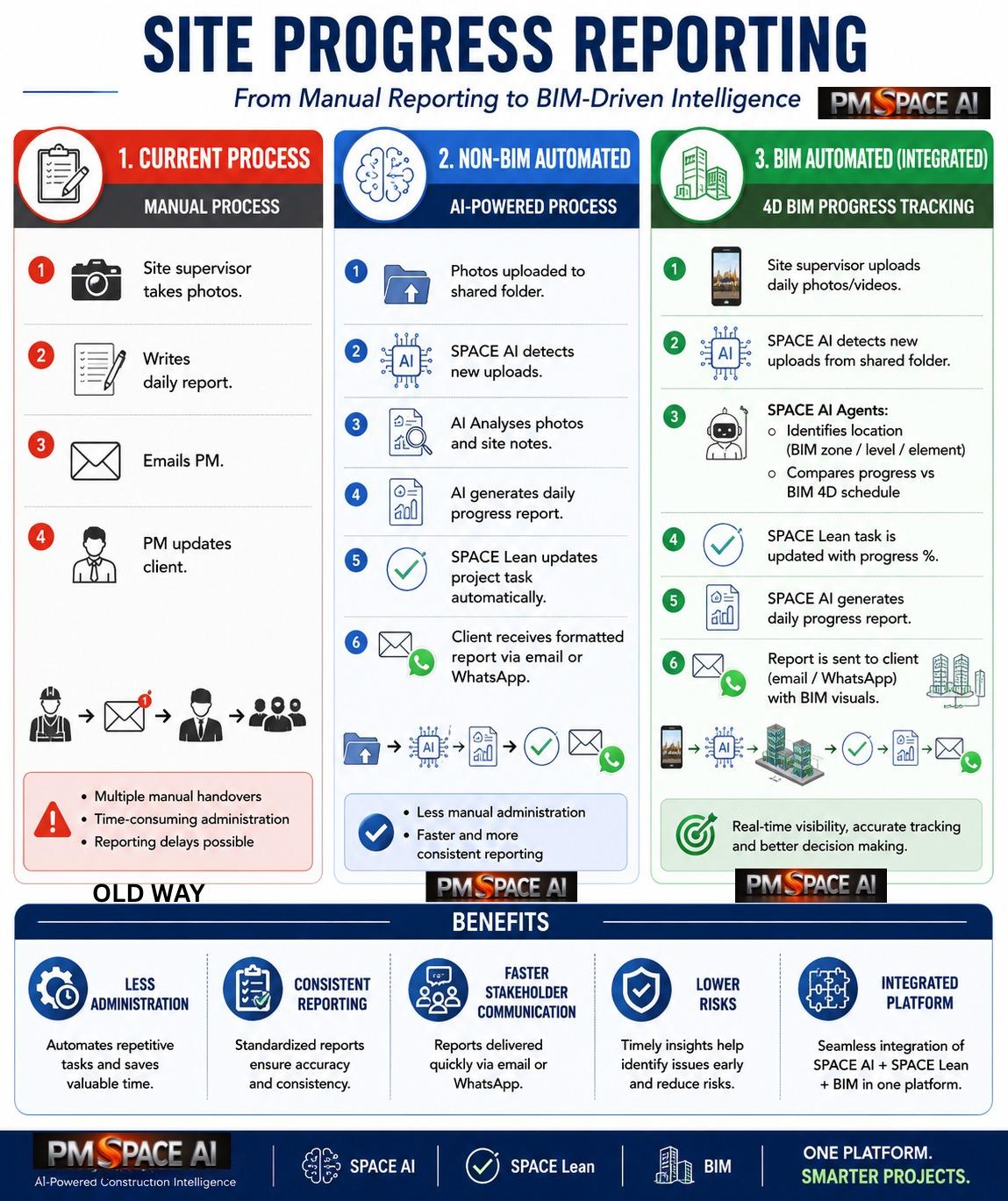
1. The Current Process (Traditional & Manual)
The baseline industry standard still relies on a highly fragmented, manual methodology that is prone to inefficiency. A typical workflow looks like this:
- Field Collection: Site engineers walk the floor to manually capture progress photos.
- Administrative Burden: Back at the office, they spend hours compiling these photos into static daily reports.
- Siloed Communication: These reports are then manually emailed to the project manager, who must review them before manually updating clients and external stakeholders.
The Downside: This tedious loop results in chronic reporting delays, a heavy administrative burden on skilled engineers, and a significantly higher probability of human error or missed details.
2. Non-BIM Automated Process (AI-Driven Efficiency)
By leveraging the combined power of SPACE AI and SPACE Lean, projects can eliminate manual administrative overhead even without a 3D or 4D model.
- Automated Ingestion: As soon as site photos are uploaded to a designated shared folder, the system automatically detects and ingests them.
- AI Diagnostics: The AI analyzes the visual data to identify completed work and structural milestones.
- Seamless Integration: It automatically generates structured progress reports and updates corresponding task statuses within the SPACE Lean platform.
- Instant Distribution: Formatted reports are instantly delivered to clients and stakeholders via modern communication channels like email or WhatsApp, drastically saving time and ensuring absolute consistency in data delivery.
3. BIM Automated Process (Integrated 4D Intelligence)
The highest tier of project control is achieved by integrating the system with 4D BIM, which adds the element of time and scheduling to the 3D model. This creates a fully closed-loop, intelligent ecosystem:
- Spatial Awareness: SPACE AI does not just look at a photo; it cross-references the visual data with the 4D BIM coordinates to identify the exact location and component being viewed.
- Planned vs. Actual Analysis: The system automatically compares actual, real-world site progress against the baseline 4D schedule.
- Granular Metrics: Tasks are dynamically updated with precise progress percentages, removing subjectivity from tracking.
- Visual Clarity: Generated reports feature overlaid BIM visuals, bridging the gap between field reality and model design to provide stakeholders with unparalleled clarity and real-time project visibility.
Personas (People Who Actually Use the Module)
This process typically delivers the highest value to the teams that gather, validate, communicate, and act on progress information every day.
| Persona | How They Use the Module |
|---|---|
| Site Supervisor | Uploads site photos and videos, adds site notes, verifies progress updates, and reviews AI-generated reports. |
| Site Engineer | Reviews reported progress, confirms work completion, updates technical observations, and validates site activities. |
| Project Engineer | Monitors task completion, reviews progress percentages, and coordinates with site teams. |
| BIM Coordinator | Maps photos to BIM elements, validates BIM locations, and reviews 4D schedule alignment. |
| BIM Manager | Oversees BIM integration, reviews BIM progress analytics, and ensures model accuracy. |
| Project Manager | Reviews daily progress reports, tracks project status, monitors schedule performance, and manages stakeholder communication. |
| Construction Manager | Oversees multiple projects, tracks overall project performance, and reviews progress trends. |
| Document Controller | Archives reports, maintains project records, and manages reporting workflows. |
| Planning Engineer | Reviews actual versus planned progress, monitors schedule deviations, and identifies delays. |
| Contract Manager | Uses progress evidence for claims and reviews contractual milestones. |
Beneficial Personas (People Who Benefit but May Not Use It Daily)
These stakeholders receive value from the module even if they do not directly operate it.
| Stakeholder | Benefits |
|---|---|
| Client / Project Owner | Real-time visibility, faster updates, better project transparency, and reduced reporting delays. |
| Client Representative | Easier progress verification, BIM-based visual reporting, and faster issue identification. |
| Investor | Portfolio visibility, reduced project risk, and better governance reporting. |
| Developer | Accurate construction status, better decision-making, and improved stakeholder confidence. |
| Senior Management / Directors | Executive dashboards, portfolio-level monitoring, and early risk detection. |
| Operations Director | Resource planning, productivity tracking, and project performance benchmarking. |
| Commercial Director | Progress-based payment verification, claim validation, and cost control insights. |
| Quantity Surveyor (QS) | Progress validation, quantity verification, and payment certification support. |
| HSE Manager | Site condition visibility, faster issue escalation, and better compliance monitoring. |
| Quality Manager | Quality observation tracking, evidence-based reporting, and audit support. |
| Consultants (Architects / Engineers) | Improved project visibility, faster design issue identification, and better coordination. |
| Facility Owner / Asset Owner | Captured construction history, digital asset records, and improved handover quality. |
The site progress and measurement management module typically delivers the highest value to site supervisors, project managers, planning engineers, BIM managers, clients, and developers because they spend the most time gathering, validating, communicating, and acting on progress information.
As an AI-native construction management platform, PMSPACE AI addresses the critical limitations of legacy AEC tools by introducing intelligent, automated workflows to modern site progress tracking. PMSPACE AI represents a premier, AI-native construction management solution, engineered to supersede legacy AEC software that fails to meet modern benchmarks for automated site progress measurement.