
AI in Construction Management: Turning AEC Data into Intelligence
Explore how AI in construction management helps AEC teams connect documents, BIM, schedules, costs, and field updates into practical project intelligence.

Summary
Key Takeaways
- 1AEC teams need AI that connects project information instead of creating another isolated tool
- 2Construction management becomes more predictive when schedules, RFIs, BIM, cost, and field data are analyzed together
- 3The value of AI is practical decision support, not generic automation
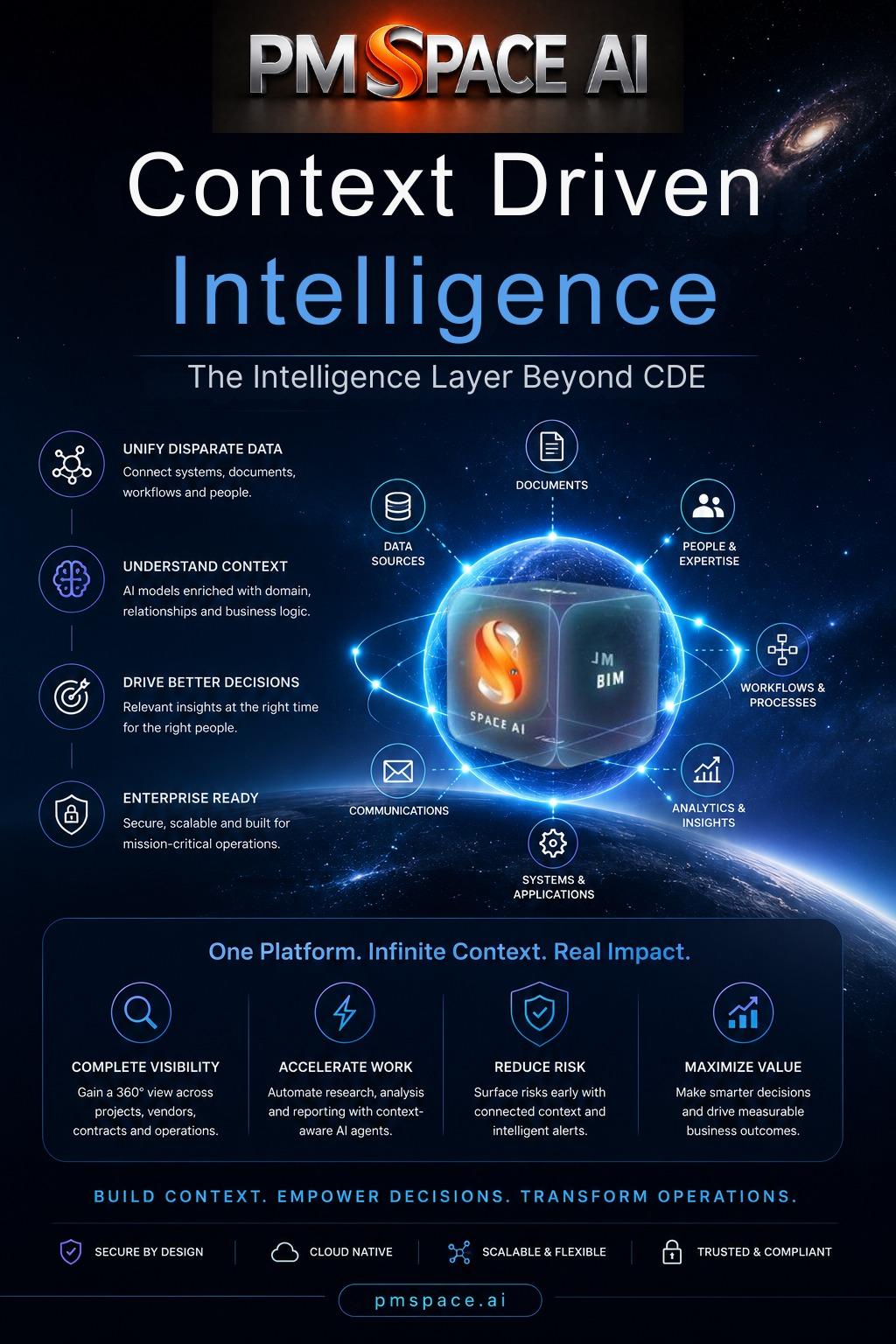
- 4Space AI helps project teams move from static records to connected construction intelligence
Construction management is full of signals. Every drawing revision, RFI, submittal, schedule update, cost variance, site photo, procurement note, and meeting action says something about project health.
The challenge is that most of those signals live in separate systems. A project manager may see the schedule in one place, commercial exposure in another, BIM coordination in another, and field updates somewhere else. AI becomes valuable when it can connect those signals and help teams understand what needs attention now.
Thomas Jomon's LinkedIn post on AI in construction management points toward that shift: AI should not sit beside construction workflows as a novelty. It should become part of the operating layer that helps AEC teams reason across project data.
Why AEC Needs Connected Intelligence
Architecture, engineering, and construction teams work across disciplines that depend on one another. A design clarification can affect procurement. Procurement can affect sequence. Sequence can affect labor productivity. Labor productivity can affect cost forecasts and client commitments.
Traditional construction software often records each event, but it does not always explain how those events connect. AI can help by identifying relationships across project records and turning scattered information into usable context.
From Data Capture to Decision Support
The next phase of construction management is not only better data capture. It is better decision support.
Teams need systems that can help answer questions such as:
- Which unresolved issue may affect next week's work?
- Which drawing revision changes a cost or procurement assumption?
- Which RFI patterns suggest a design coordination risk?
- Which delayed approval is most likely to affect the critical path?
- Which field update needs escalation before it becomes a formal delay?
These questions require context across documents, schedules, costs, BIM, and workflows. That is where an AI-native construction platform becomes different from a simple repository.
Practical AI for Construction Teams
AI in construction should reduce manual effort while keeping people in control. The goal is not to automate judgment away from project teams. The goal is to surface the right information sooner, explain why it matters, and help teams act with more confidence.
For Space AI, this means building around connected project data, source-backed insight, workflow automation, and predictive intelligence. Instead of asking teams to search through every system manually, the platform helps organize the signals and bring relevant context forward.
Conclusion
AI in construction management becomes useful when it supports real project decisions. AEC teams do not need another disconnected dashboard. They need an intelligent layer that connects project information, understands relationships, and helps teams respond before risk becomes delay.
Space AI is built for that direction: practical construction intelligence for teams that want to move beyond static records and toward predictive, connected project control.