
Space AI - Context Driven Intelligence
Discover how Space AI moves beyond the traditional CDE by connecting documents, people, workflows, systems, and analytics into decision-ready construction context.

Summary
Key Takeaways
- 1A Common Data Environment stores and exchanges information, but construction teams also need connected context for decisions
- 2Space AI links documents, data sources, people, workflows, communications, systems, and analytics into an intelligence layer
- 3Context-aware AI can surface relevant risk and opportunity to the right stakeholder at the right time
- 4The operational result is greater visibility, faster work, earlier risk response, and more measurable value
- 5Enterprise construction intelligence must remain secure, scalable, cloud-native, and governed
Construction projects are surrounded by information. Drawings, specifications, RFIs, contracts, schedules, progress reports, site photos, emails, cost forecasts, approvals, vendor records, and operational systems all contain a part of the truth.
The challenge is no longer simply capturing that information. Many organizations already have document repositories and Common Data Environment (CDE) practices designed to centralize files and coordinate exchanges. The challenge is understanding what the information means together, why it matters now, and which decision must be made next.
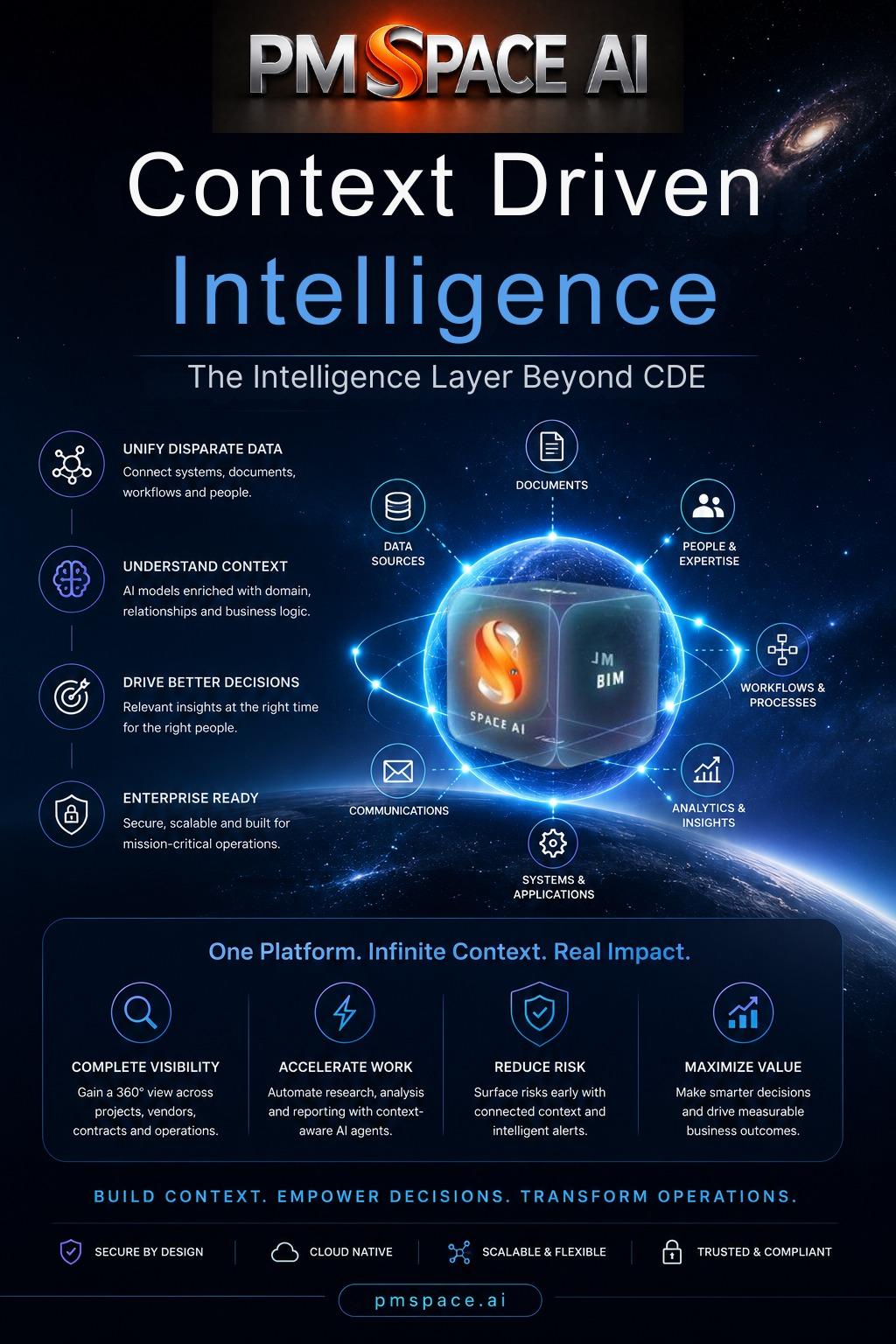
That is the central idea behind the image: Context Driven Intelligence - The Intelligence Layer Beyond CDE.
Space AI is positioned as the layer that connects project information to project meaning. It is not only about finding a document. It is about understanding how a document relates to a person, a workflow, a scheduled activity, a cost exposure, an approval, a risk, and an operational outcome.
Beyond Storage: Why Construction Needs Context
A traditional project information system can answer important questions:
- Where is the latest document?
- Which version was approved?
- Who uploaded the record?
- When did a workflow step complete?
Those answers matter. But project leaders are increasingly asked a different class of questions:
- Which unresolved decision could delay work next week?
- What drawing change affects procurement, cost, and installation sequencing?
- Which recurring site issue suggests a systemic quality or coordination risk?
- Which stakeholder needs relevant evidence before approving an action?
- What should the project team prioritize today?
Answering those questions requires context, not just data availability.
Context means understanding relationships. A document is linked to a workflow. A workflow is owned by people. A late response changes a schedule condition. That schedule condition affects a supplier or subcontractor. A cost forecast begins to move. The project consequence is found in the connections.
The image represents this idea through a connected intelligence core surrounded by the information domains that make a construction enterprise work.
The Connected Domains of Construction Intelligence
At the center of the visual is a connected Space AI intelligence layer. Around it sit six sources of operational meaning:
Documents
Documents include drawings, specifications, contracts, submittals, RFIs, change records, progress reports, and handover information. A CDE can provide control over these records. A contextual intelligence layer can help identify where a record affects work, which related records matter, and what a team should review as a consequence of a change.
People and Expertise
Construction decisions cannot be reduced to files. Owners, project managers, engineers, supervisors, designers, commercial teams, suppliers, and subcontractors bring responsibilities and expertise. Context-driven intelligence routes relevant information to the person able to act, while maintaining accountable human judgment for material decisions.
Workflows and Processes
Approvals, procurement, inspections, document reviews, change control, and site coordination are not isolated actions. They form operational chains. Space AI aims to connect workflow activity with project consequence, so a late review is understood in terms of the milestone, cost, vendor, or field activity it may affect.
Analytics and Insights
Dashboards can show performance; context helps explain it. When analytics are enriched by connected documents, workflows, ownership, and project relationships, teams can investigate causes rather than merely observe indicators. This supports earlier intervention and stronger decision quality.
Systems and Applications
Construction organizations already operate across multiple software systems. Scheduling, finance, BIM, procurement, collaboration, and field reporting often live in separate applications. A context-driven intelligence layer is valuable when it can connect signals across that environment rather than requiring teams to manually reconstruct the project picture.
Communications
Many critical project decisions emerge through communication: a query, a review comment, an approval request, a supplier update, or an escalation. Connecting communications to the related project record and action helps preserve project memory and reduces the chance that important context disappears inside fragmented threads.
Four Outcomes of Context-Driven Intelligence
The left side of the visual outlines a practical progression from disconnected data to operational impact.
1. Unify Disparate Data
Projects cannot become intelligent while essential information remains fragmented. Unification connects systems, documents, workflows, and people so that relevant data can be considered together. The goal is not to replace every source system; it is to build a usable intelligence layer across project information.
2. Understand Context
AI becomes more useful when it understands domain relationships and business logic. In construction, that may include connections among a drawing revision, a work package, an approval, a procurement requirement, a milestone, and a commercial consequence.
Context reduces generic output. Instead of simply summarizing a record, an intelligent system can support questions about impact, responsibility, urgency, and related evidence.
3. Drive Better Decisions
Decision support matters only when insight arrives at the right time and to the right people. A warning that appears after work is delayed is a historical explanation. A risk signal surfaced while the team can still act is operational intelligence.
Space AI's vision is to help teams move from searching and reconciling information to reviewing connected insight and taking accountable action sooner.
4. Be Enterprise Ready
Construction data is commercially sensitive and operationally critical. Any intelligence layer serving real projects must be secure by design, scalable across teams and projects, flexible enough to work with existing environments, and aligned with governance and compliance expectations.
The visual correctly positions enterprise readiness as part of the concept, not an afterthought. Intelligence cannot become trusted operational infrastructure unless teams trust how information is accessed, connected, governed, and used.
One Platform, Infinite Context, Real Impact
The image summarizes the operational promise in four outcomes.
Complete Visibility
Connected intelligence gives teams a clearer view across projects, vendors, contracts, documents, workflows, and operations. Visibility is not simply more dashboards. It is the ability to locate relevant evidence and understand relationships when a decision is under pressure.
Accelerate Work
Project teams spend significant effort gathering updates, researching the source behind a question, and assembling reports. Context-aware AI agents can support research, analysis, follow-up, and reporting by working from connected project information rather than isolated inputs.
Reduce Risk
Risks often appear first as weak signals: a late response, a recurring issue, a vendor constraint, a shifted drawing, or a cost trend. Connecting those signals helps teams surface exposure earlier, with enough context to evaluate and respond.
Maximize Value
Better decisions should result in better business outcomes. When construction organizations reduce avoidable searching, identify risk sooner, improve coordination, and use project knowledge repeatedly, intelligence becomes measurable operational value rather than a technology experiment.
From a CDE to a Construction Intelligence Layer
A CDE remains an important foundation for controlled project information. Context Driven Intelligence does not dismiss that foundation. It builds beyond it.
The next generation of construction operations needs systems that can connect records to relationships, relationships to consequences, and consequences to timely action. It needs project intelligence that helps teams understand not only what exists, but what matters.
That is what the visual communicates:
- Build context across the project information environment.
- Empower people with relevant, decision-ready insight.
- Transform operations through connected and responsible intelligence.
Conclusion
Space AI - Context Driven Intelligence expresses a clear vision for modern construction enterprises. Documents, people, systems, communications, workflows, and analytics should no longer remain isolated sources of information. Together, they can become an intelligence layer that improves visibility, accelerates work, reduces risk, and supports measurable value.
For organizations ready to move beyond disconnected project records, Space AI represents a path toward context-aware construction operations: secure by design, cloud native, scalable, flexible, and built for better decisions.