
Budget Tracking for Contractors: 2026 Guide
A guide to construction budget tracking: protect margins, improve cash flow visibility, and replace spreadsheets with modern software.

A project can look perfectly profitable on paper and bleed cash in reality. The estimate was solid, the bids came in right, and somewhere between breaking ground and final billing, the margin quietly disappeared. Untracked change orders, labor that ran long, materials purchased outside the budget — none of it catastrophic on its own, all of it devastating in combination.
Budget tracking for contractors is not just about knowing where your money went. It is about knowing where it is going while you still have time to act. This guide covers the anatomy of a contractor budget, the best practices that separate profitable firms from struggling ones, and the tools that make real-time financial visibility achievable for teams of any size.
What are the 3 parts of a construction budget?
Every construction budget consists of three core components: Hard Costs, Soft Costs, and Contingencies. Together, they define the full financial scope of a project. Understanding these parts is foundational to strong construction budget management.
Hard Costs (Direct Costs)
Hard costs include all direct project expenses such as labor, materials, and equipment. These are the costs physically tied to building the project:
- Wages and subcontractor payments
- Concrete, steel, lumber, and finishes
- Heavy equipment rental
- Site utilities and temporary works
Hard costs usually represent 60–80% of total project value. Because of their size, even small tracking errors here can significantly affect job costing for builders. Failing to track construction costs accurately at this level can cause margins to evaporate quickly.
Soft Costs (Indirect Costs)
Soft costs are indirect expenses required to complete the project but not directly tied to physical construction. These include:
- Permits and licensing fees
- Architectural and engineering fees
- Insurance and bonding
- Project management salaries
- Software and administrative expenses
Many contractors underestimate soft costs or treat them as fixed. In reality, they fluctuate — especially if a project runs longer than planned. Strong construction budget tracking includes visibility into both direct and indirect cost layers.
Contingency Funds
Contingency funds are reserved buffers (typically 5–15% of total budget) designed to absorb unexpected costs. No project is immune to surprises:
- Material price spikes
- Unforeseen site conditions
- Weather delays
- Minor scope changes
Without contingency planning, small deviations can turn into full-scale crises. For deeper strategies on risk mitigation, explore our guide on preventing construction cost overruns [/blogs/construction-cost-overruns-guide].
[Image 1 Placeholder] Filename: construction-budget-tracking-cost-breakdown.png Alt Text: "Breakdown of hard costs, soft costs, and contingency funds in a construction budget tracking framework"
How Do You Track a Construction Budget Effectively?
Effective construction budget tracking requires four core practices working together:
- Implement job costing — assign cost codes to every expense so spending is traceable at the line-item level
- Track in real time — monitor actuals against the budget continuously, not at month-end
- Manage change orders immediately — document and price every scope change before work begins
- Look ahead, not just back — use forecasting tools to project where costs are trending, not just where they have been
Implement Job Costing Job costing assigns every project expense — labor hours, material invoices, subcontractor billings, equipment charges — to a specific cost code that maps to a line item in the original estimate. Without cost codes, your budget is a single number. With them, it becomes a detailed map of where money is being spent relative to plan. Job costing answers questions that aggregate tracking cannot, such as which trade is running over, labor variance concentrations, and material overages.
Track in Real Time End-of-month reports are too late for construction cash flow management. Real-time construction budget tracking means costs are entered, coded, and visible against the budget as they occur. This is the operational difference between managing a project and reporting after the fact.
Manage Change Orders Immediately Unmanaged scope changes can destroy a project margin. A disciplined change order process treats every scope change as a budget event. No verbal approvals. Every addition or deletion is documented, priced, approved in writing, and the budget updated immediately.
Look Ahead, Not Just Back Budget tracking tells you where your money has gone. Forecasting tells you where it is going. Using AI forecasting in construction helps teams catch potential cost issues weeks before they escalate.
What is the best way to track construction costs?
The best way is to replace manual spreadsheets with integrated construction budget tracking software that connects estimating, purchasing, billing, and change management into one live system. Spreadsheets fail because they:
- Require manual updates
- Create version conflicts
- Lack real-time visibility
- Separate scheduling from financial data
- Make forecasting nearly impossible
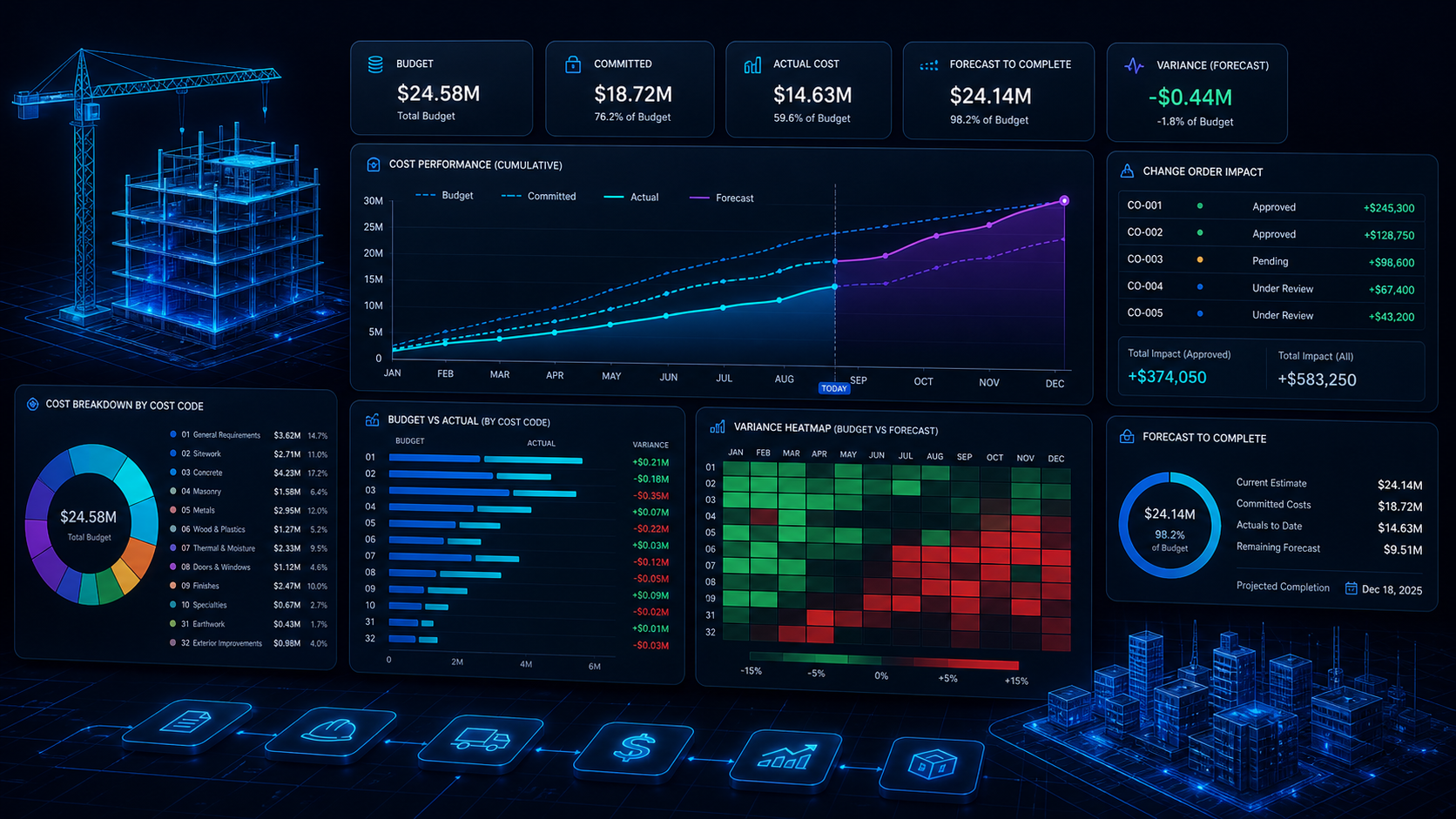
PMSpace replaces this fragmented approach with a unified financial platform where every dollar is tracked from estimate to invoice. Purchase orders match budget line items automatically. Subcontractor billings are checked against contracted scope before approval. Change orders update budgets instantly, giving every stakeholder a live view of project status.
[Image 2 Placeholder] Filename: construction-budget-tracking-software-live-dashboard.jpg Alt Text: "Live budget vs actual cost tracking dashboard inside PMSpace construction budget tracking software"
Frequently Asked Questions About Contractor Budgets
How Do You Create a Budget for a Construction Company?
Start with historical data from completed projects, gather accurate subcontractor bids, fully account for overhead and soft costs, and establish a contingency baseline. Build budgets using real job costing data, not industry averages. Layer in current quotes, overhead allocation, and contingency, then treat every deviation as a formal change event.
Why Do Construction Budgets Fail?
Budgets fail due to inaccurate initial estimates, poor cash flow planning, and disconnected tracking that prevents real-time visibility. Even projects finishing on budget can create financial strain if costs front-load while billings lag.
Do Small Contractors Need Budget Tracking Software?
Yes. Small contractors need budget tracking software more than large firms because thin margins leave little room for error. Even a minor overrun can eliminate project profit. Software extends small teams’ financial monitoring capacity, providing real-time cost visibility and variance detection.