
AI Forecasting in Construction: Predict Costs, Reduce Risks, and Improve Project Outcomes
Discover how AI forecasting in construction predicts cost overruns, schedule delays, and resource shortages before they happen. Learn key benefits, real-world applications, and how to implement AI forecasting on your projects.

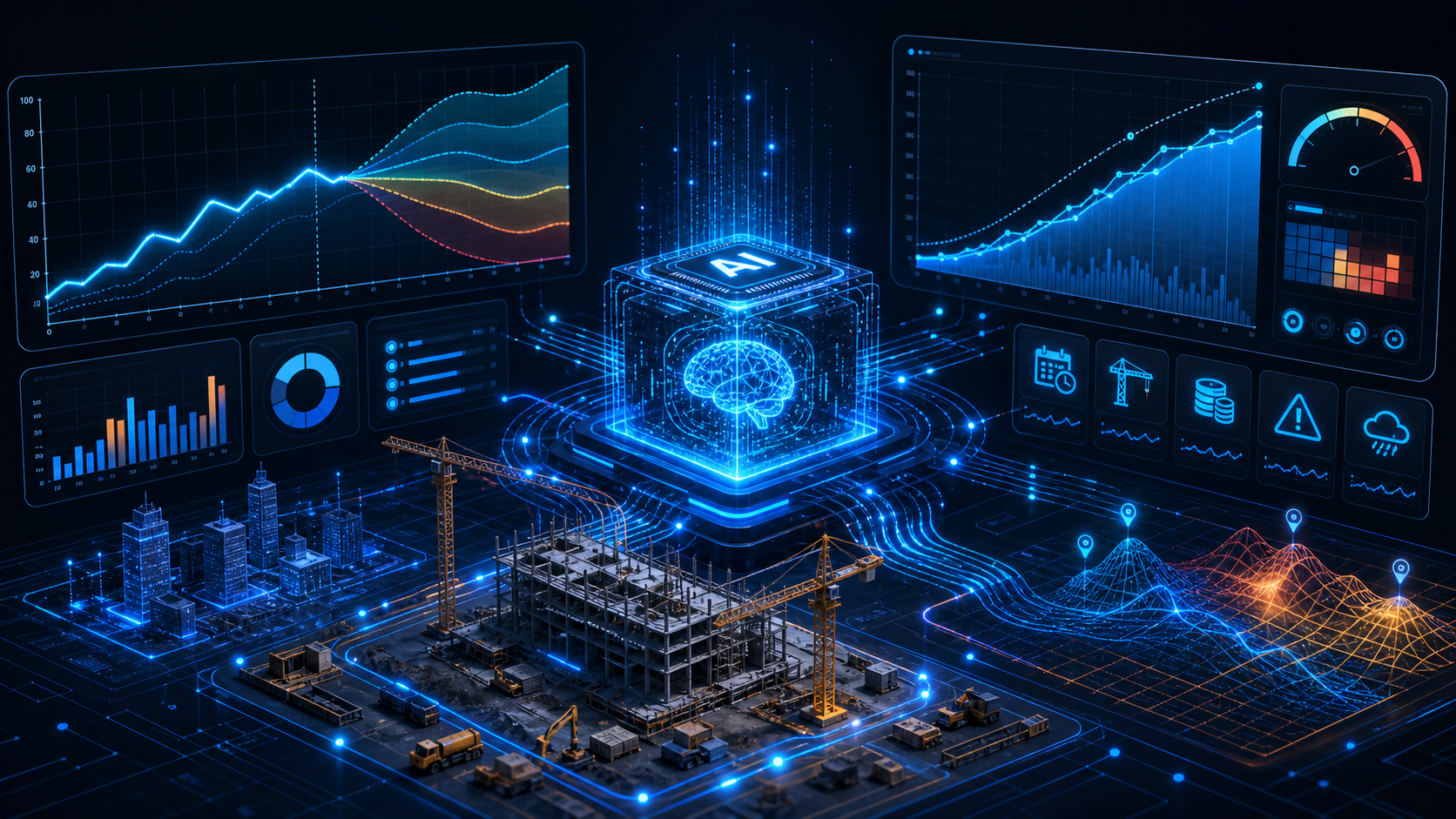
Construction projects have always struggled with budget shifts, timeline slippage, and reactive management. A subcontractor falls behind and you scramble to resequence work. A material delivery slips and you find out when the crew is already waiting on site. Costs run over and you discover it at month-end reconciliation, weeks after the moment when something could have been done.
AI forecasting changes this entirely. By analyzing real-time data, identifying patterns, and predicting future outcomes early, AI gives project teams the visibility to act before small issues become costly crises.
What Is AI Forecasting in Construction?
AI forecasting in construction uses machine learning and predictive analytics to continuously update project predictions based on both historical and real-time data. Rather than reacting to problems after they surface, AI-equipped teams receive early warnings that allow them to intervene while there is still time to course-correct.
This is a fundamental shift from how construction has always worked. Traditional project management answers "what happened?" AI forecasting answers "what is going to happen and what should we do about it?"
Why Traditional Forecasting Falls Short
Reliance on Static Data
Traditional forecasting relies on snapshots of project data taken at a single point in time. By the time a report is compiled and reviewed, conditions have already changed. Static data cannot capture the dynamic, fast-moving nature of active construction projects.
Limited Visibility into Project Performance
Without real-time data integration, project managers are often working with incomplete information. Issues in one area of a project may not surface in reports until they have already impacted multiple downstream tasks.
Human Error and Bias
Manual forecasting processes are prone to human error and cognitive bias. Optimism bias in particular leads teams to underestimate risks and overestimate project performance, especially when projects are already under schedule or budget pressure.
Key Benefits of AI Forecasting in Construction
Accurate Cost Prediction
AI tracks cost burn against project progress and warns when spending trends indicate a future overrun. Instead of discovering budget problems at closeout, teams can correct course early. Paired with dedicated construction cost management software, AI forecasting gives finance and project teams a unified view of where money is going and why.
Improved Scheduling and Timeline Forecasting
Schedule delays rarely happen suddenly -- they build from small issues that compound over time. AI construction scheduling tools detect these patterns early. If a material delay is detected and it impacts upcoming tasks, the system immediately flags the issue and models downstream effects so teams can act before the disruption spreads.
Early Risk Detection
AI identifies risk signals that human reviewers often miss. By analyzing patterns across hundreds of past projects, the system learns what combinations of factors typically precede delays, overruns, or safety incidents -- and alerts teams when those patterns appear in a current project.
Better Resource Planning
Construction inefficiencies often come from poor timing of resources. AI analyzes project pace in real time and predicts exactly when subcontractors and materials are needed. This reduces idle time, avoids bottlenecks, and keeps workflows optimized.
Real-World Applications of AI Forecasting
AI forecasting is already delivering measurable results across construction sectors. General contractors use predictive analytics to model schedule risk on complex multi-phase projects. Specialty subcontractors use it to optimize crew deployment and reduce overtime. Owners and developers use it to get earlier, more reliable project status reporting.
For teams managing multiple simultaneous projects, AI forecasting tools integrated with construction expense management software create a complete picture of financial performance across the entire portfolio -- not just project by project.
How to Implement AI Forecasting Effectively
Build a Strong Data Foundation
AI forecasting is only as good as the data behind it. Start by centralizing project data -- schedules, budgets, daily logs, RFIs, and change orders -- into a single platform. The more historical project data the system can learn from, the more accurate its predictions become.
Integrate AI with Existing Systems
AI forecasting works best when it is embedded into your existing workflows rather than bolted on as a separate tool. Look for platforms that integrate scheduling, cost tracking, document management, and risk monitoring in one place.
Focus on Real-Time Data Collection
The predictive value of AI comes from continuous monitoring. Equip field teams with mobile tools that capture daily progress, issue logs, and resource utilization in real time so the system always has current data to work from.
Train Teams to Use AI Insights
Technology adoption fails when teams do not trust or understand the outputs. Invest in training so that project managers and site supervisors understand what the AI is flagging, why, and what actions to take in response.
Start with High-Impact Use Cases
Rather than trying to apply AI forecasting to everything at once, start with the highest-impact use cases for your business. Schedule delay prediction and cost overrun forecasting typically deliver the fastest, most measurable returns.
Use Scalable Platforms
Choose platforms that can grow with your business. AI construction management software built for scalability allows you to start with core forecasting features and expand into more advanced capabilities as your team builds confidence and your data set grows.
Challenges in AI Forecasting Adoption
Despite its benefits, AI forecasting adoption in construction faces real barriers. Data quality and consistency remain the biggest challenge -- many firms lack the structured historical project data needed to train accurate models. Integration with legacy systems adds complexity. And organizational resistance to change slows rollout even when the technology works well.
Firms that overcome these challenges typically do so by starting small, demonstrating early wins, and building internal champions who understand both the technology and the construction workflow.
The Future of AI Forecasting in Construction
AI forecasting capabilities are advancing rapidly. The next generation of construction AI will combine predictive analytics with autonomous project monitoring -- systems that not only flag risks but recommend specific corrective actions and model the downstream impact of different responses.
As AI becomes embedded in standard construction platforms, the competitive gap between firms that adopt it and those that do not will widen. Teams with access to accurate, real-time forecasting will consistently deliver better project outcomes, win more bids, and protect margins more effectively than those still relying on spreadsheets and reactive management.
Frequently Asked Questions
Will AI replace construction project managers?
No. AI enhances project managers by removing manual analysis and providing faster insights. Project managers still lead teams, communicate with stakeholders, and make critical decisions. AI handles the data-intensive monitoring work so managers can focus on judgment and leadership.
Is AI forecasting accurate for construction?
AI forecasting improves over time as it learns from project data. While it cannot predict with absolute certainty, it significantly improves early risk detection compared to traditional methods. Most platforms report 70-85% accuracy on schedule and cost deviation warnings.
Do small construction companies need AI forecasting?
Yes. Small construction companies often operate on tight margins where a single overrun can threaten the business. AI forecasting provides early warnings that help prevent costly delays and overruns -- and modern platforms make it accessible without enterprise-level budgets or IT teams.
How long does it take to implement AI forecasting?
Most cloud-based AI forecasting platforms can be deployed and producing initial insights within two to four weeks. Full value -- where the system has enough project history to deliver highly accurate predictions -- typically takes two to three completed project cycles.
Take Control of Your Projects with AI-Powered PMspace
The future of construction belongs to teams that can anticipate problems before they happen. AI forecasting transforms project management from reactive to proactive -- giving you the visibility to protect margins, hit deadlines, and build a reputation for reliable delivery.
PMspace brings enterprise-level AI forecasting to construction teams of all sizes without enterprise complexity. By integrating predictive analytics into everyday workflows, it enables builders to operate smarter, reduce risk, and scale with confidence.