
Why Construction AI Needs a Contextual Layer That Learns Continuously
See why visual project data alone is not enough and how a continuously learning contextual layer improves construction decisions.

Summary
Key Takeaways
- 1Visual records are useful, but they do not preserve full project context by themselves
- 2Construction AI needs relationships across tasks, documents, costs, vendors, and decisions
- 3A contextual layer improves project memory and decision quality over time
- 4Continuous learning helps teams detect repeated patterns across active projects
- 5PMSPACE AI connects visual and operational data into a stronger intelligence layer
Construction teams capture a lot of visual information. Site photos, drawings, models, dashboards, markups, and progress views all help teams understand what is happening.
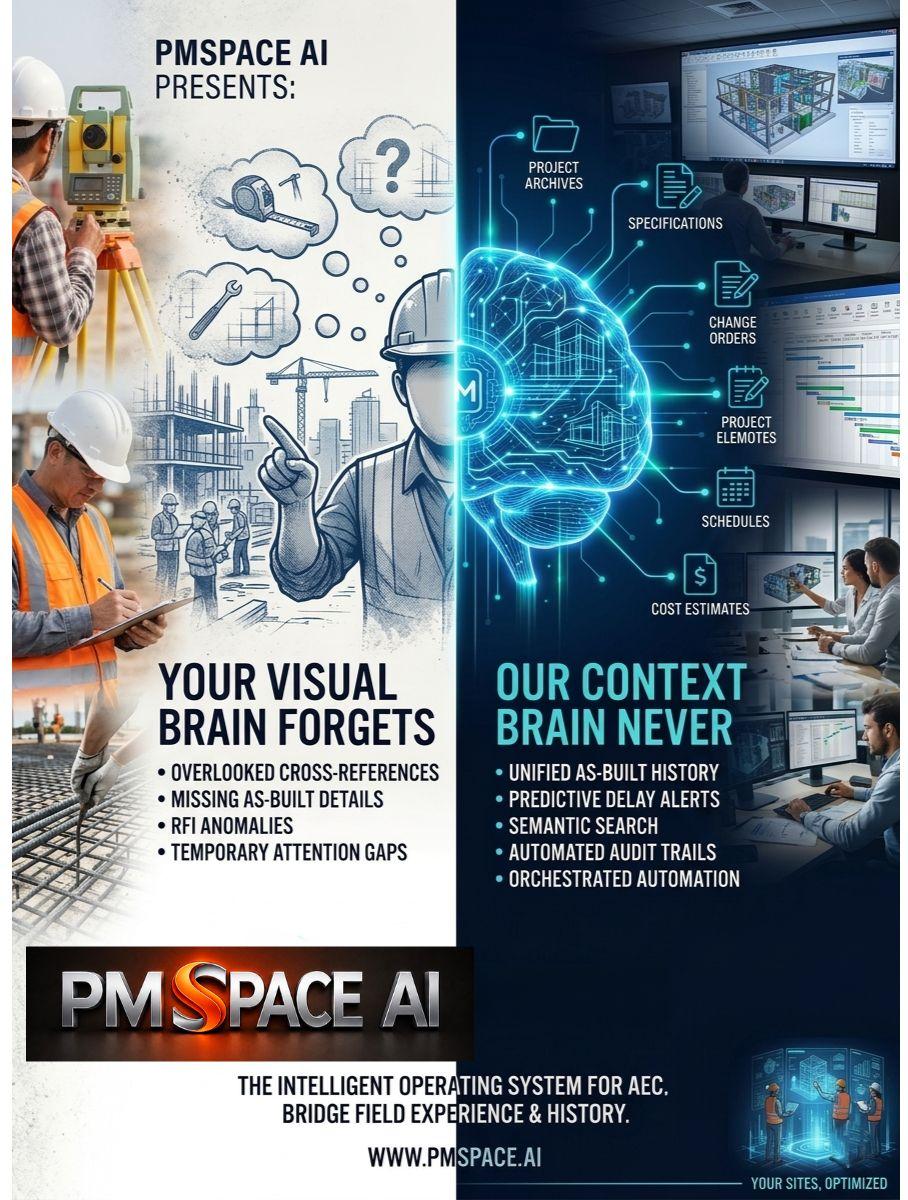
But visual data alone has a weakness: it often forgets the context around the work. A photo may show progress, but not why a task changed. A drawing may show a revision, but not which cost item or schedule activity it affects. A dashboard may show a risk, but not the chain of decisions behind it.
That is why modern construction AI needs a contextual layer that learns continuously. It must connect what teams see with what teams know, decide, approve, purchase, and execute.
The Limits of a Visual-Only Layer
Visual tools help teams inspect project status, but they rarely capture the full meaning behind project activity.
A visual layer may show:
- A work area is incomplete
- A drawing has changed
- A model element has been updated
- A progress photo was taken
- A dashboard metric moved
Those signals are useful, but they are incomplete without context.
Teams still need to know:
- Which activity is affected?
- Who owns the next action?
- Which document caused the change?
- What cost impact is attached?
- Which procurement item may now be delayed?
- Which prior decision explains the current condition?
What a Contextual Layer Does
A contextual layer connects project information across workflows. It links visual evidence to schedules, RFIs, change orders, cost codes, vendors, documents, field updates, and ownership.
Instead of treating every record as a separate object, it understands how each piece of information relates to the others.
For construction AI, this is essential. AI recommendations become stronger when the system understands the relationships behind project events.
Why Continuous Learning Matters
Construction projects change every day. Static rules are not enough. A contextual layer must learn continuously from new project activity.
It Builds Project Memory
When a decision is made, the system should remember what triggered it, who approved it, what documents were involved, and what downstream impact followed.
It Detects Repeated Patterns
If the same kind of RFI delay repeatedly affects procurement or inspections, the system can learn that pattern and flag similar situations earlier on future projects.
It Improves Recommendations
AI can recommend better actions when it understands historical outcomes. The platform can learn which mitigations worked, which suppliers caused repeated delays, and which workflows created bottlenecks.
Construction Examples
A continuously learning contextual layer can support practical use cases such as:
- Linking progress photos to schedule activities
- Connecting drawing revisions to impacted work packages
- Mapping RFIs to blocked tasks and responsible teams
- Tracking procurement risk against upcoming milestones
- Learning recurring cost-overrun patterns across projects
- Connecting field observations with quality and safety workflows
These use cases require more than visual capture. They require connected context.
How PMSPACE AI Applies Context
PMSPACE AI connects project workflows so teams can move beyond fragmented project views. The platform brings together documents, schedules, costs, procurement, field updates, and AI analysis into one intelligent operating layer.
That means visual information is not treated as a dead snapshot. It becomes part of a living project memory that helps teams understand cause, impact, and next action.
Conclusion
The visual layer is valuable, but it is not enough by itself. Construction AI needs context that learns continuously from the way work actually happens.
By connecting visual signals with operational data, PMSPACE AI helps teams build project intelligence that remembers, learns, and improves decision-making over time.