
Kill the Ontology Bottleneck in Construction AI
Learn how construction teams can stop slow manual data mapping and move toward AI-ready project intelligence with connected construction data.

Summary
Key Takeaways
- 1Manual ontology mapping slows down construction AI adoption
- 2Connected project data helps teams move from data preparation to real execution
- 3AI-ready construction systems need context across documents, schedules, costs, and field workflows
- 4A unified data layer reduces duplicate work and improves decision speed
- 5PMSPACE AI helps teams build intelligence on top of live construction operations
Construction companies are collecting more data than ever, but much of that data still sits in disconnected systems. Schedules live in one place. RFIs live somewhere else. Costs, drawings, field reports, vendor records, and approvals each carry their own structure.
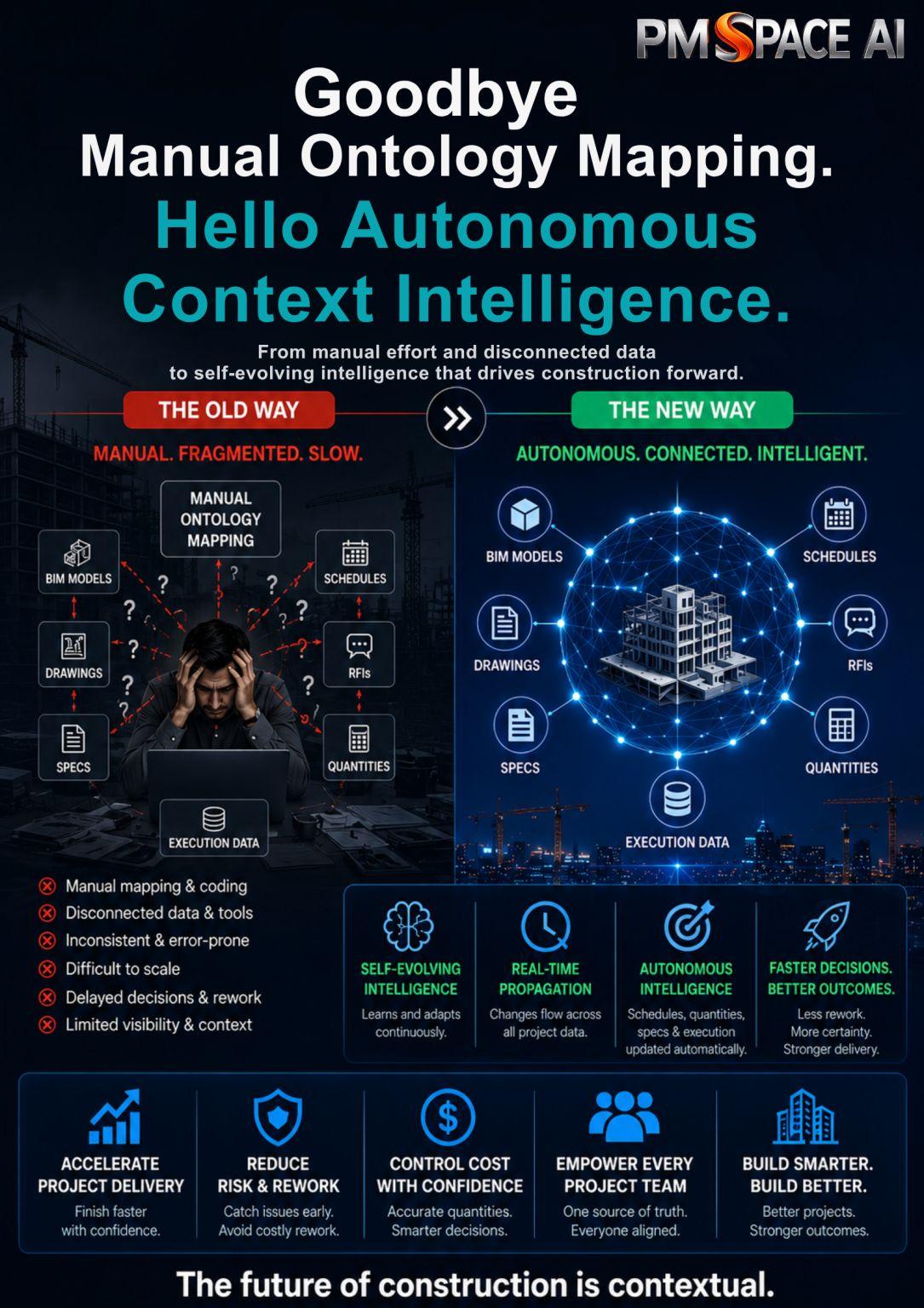
Before teams can use AI meaningfully, someone usually has to map all of those concepts together. That mapping work is the ontology bottleneck. It is slow, technical, and difficult to maintain as projects change.
The result is frustrating: teams spend too much time preparing data and not enough time using intelligence to manage work. To move faster, construction organizations need systems that understand project context as work happens.
What Is the Ontology Bottleneck
An ontology defines how concepts relate to each other. In construction, that means connecting entities such as activities, documents, cost codes, subcontractors, materials, approvals, assets, and risks.
The bottleneck appears when teams need to manually define and maintain these relationships before AI can provide useful answers.
For example:
- Which RFI blocks which activity?
- Which drawing revision affects which work package?
- Which cost code is tied to a change order?
- Which supplier delay threatens which milestone?
- Which subcontractor owns the impacted scope?
If these relationships are not connected, AI has to work with isolated records instead of real project context.
Why Manual Mapping Slows Construction Teams Down
Manual mapping may work in small pilots, but it becomes painful at enterprise scale. Every project has different naming conventions, workflows, subcontractors, codes, and document structures.
Project Data Changes Constantly
Construction projects are not static. RFIs are answered, schedules shift, drawings are revised, and costs change. A manually maintained ontology can become outdated quickly.
Teams Lose Time Before Seeing Value
AI initiatives often stall because too much effort goes into setup. Teams want insight into delay risk, cost exposure, and document impact. They do not want months of data preparation before the platform becomes useful.
Context Is Hard to Rebuild After the Fact
When relationships are not captured during execution, teams have to reconstruct context later. That creates errors and weakens AI recommendations.
The Better Path: Build Intelligence Into the Workflow
The answer is not more manual mapping. The answer is a construction intelligence layer that captures relationships as part of everyday work.
When RFIs, documents, schedules, costs, procurement records, and field updates are connected in one operating environment, the system can learn context continuously.
This gives AI the foundation it needs to answer practical questions:
- What is blocked right now?
- Which change has the largest downstream impact?
- What risk is emerging from current project activity?
- Which team needs to act next?
- What decision will protect the schedule?
How PMSPACE AI Reduces the Bottleneck
PMSPACE AI is designed around connected construction intelligence. Instead of treating project records as isolated files, the platform links operational data across workflows.
That connected layer supports:
- Delay propagation analysis
- Change-order impact tracking
- Document-to-task relationship mapping
- Cost and procurement visibility
- Supplier and subcontractor context
- Cross-project learning patterns
This lets teams move from mapping to building. The system becomes useful because it works with the real relationships inside project delivery.
Why This Matters for AI in Construction
AI in construction is only as strong as the context behind it. A model that sees disconnected records may summarize information, but it cannot reliably explain impact or recommend action.
A context-aware platform can go further. It can identify dependencies, detect risk chains, and surface the next best action for project teams.
That is the difference between a construction data repository and a construction system of intelligence.
Conclusion
The ontology bottleneck is one of the biggest barriers to practical construction AI. Teams do not need another slow mapping exercise. They need connected workflows that capture project relationships naturally.
By unifying project data and making context available to AI, PMSPACE AI helps construction teams stop preparing forever and start building smarter.